Siena · 6 March 2026 · Italo Calvino Hall
Beyond the Dust of the Strade Bianche
Use the ← → keys or the buttons below to navigate the slides.

Beyond the Dust of the Strade Bianche
New Frontiers in Cycling Science
Advanced Techniques for Training Data Analysis
Andrea Zignoli
Department of Industrial Engineering · University of Trento, Italy
Today's Topics
1 / 14- 1.Single-session power profile and the cyclist's power profile
- 2.How to derive intensity zones from a power profile
- 3.Static and dynamic zones
- 4.Margins relative to best performance
- 5.Strengths and limitations of the methodology
Power Profile: Session MMP
1 / 14MMP History: Training Block
1 / 14Power-Duration Curve: CP · MAP · PPO
1 / 14Training Zones: CP · MAP · PPO
1 / 14Physiological Resilience: The 4th Dimension
1 / 14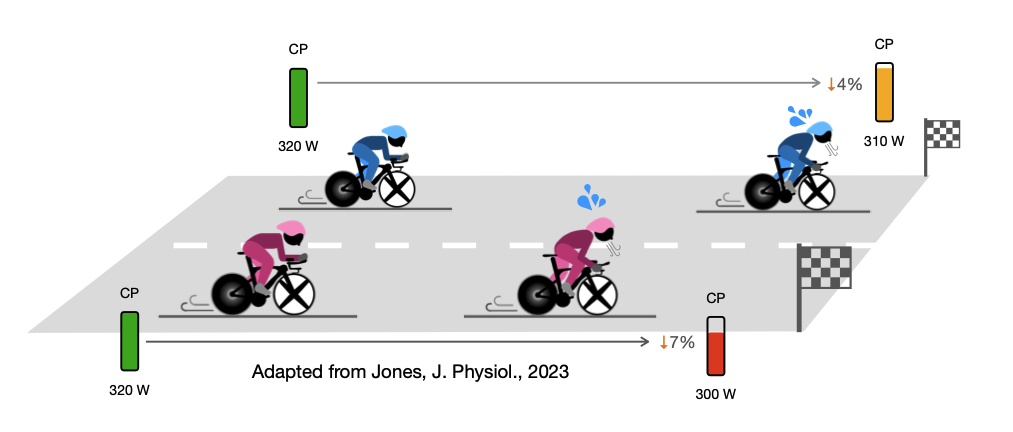
Endurance performance rests on three classical pillars: VO₂max, movement economy, and the sustainable fraction (associated with the lactate threshold). These are measured at the start, but they do not remain constant.¹
After 2 hours of hard cycling, Critical Power (CP) can decline on average by ~10%, with individual declines ranging from <1% to ~32%.
Physiological resilience, the ability to preserve these variables under fatigue, is proposed as a fourth dimension of endurance performance, with direct implications for athlete assessment and race pacing.
Critical Power Resilience: Session View
1 / 14Static Thresholds, Dynamic Reality
1 / 14CP is assessed as a static threshold, but it shifts unpredictably during a race or a training session.
With MMPs, on the other hand, we always know the margin between the current effort and the best recorded performance.
This makes MMPs a practical reference for real-time and post-race analysis, regardless of fatigue state.
Session Analysis: Rolling MMP Ratio
1 / 14One Margin to Watch
1 / 14What if, instead of evaluating all margins separately, we dropped all rolling averages and showed only the one closest to the athlete's MMP limit?
At any moment during a race or training session, this single value indicates which duration is most critically stressed relative to the athlete's best performance.
It gives one compact, interpretable signal that captures the dominant physiological stress at each instant.
Workout Reserve: Coppi & Bartali 2025, Stage 2
1 / 14Strengths and Limitations
1 / 14We can never be certain the profile is truly maximal.
The main limitation of the power profile approach is that we do not know how "real" it is: whether the recorded efforts were truly maximal and representative of the athlete's capacity.
Margins are always computable and informative.
When MMPs are used to prescribe training sessions or to analyze a session post hoc, we can always evaluate the margin between the current effort and the best recorded performance. The MMP with the smallest margin may also indicate the main physiological limitation at that moment.
The approach is model-free and practical.
No assumptions about the shape of the power-duration curve are required. Any training software can compute rolling averages, so the method is easy to apply in practice.
Beyond the Dust of the Strade Bianche
New Frontiers in Cycling Science
Thank you.
Andrea Zignoli
Department of Industrial Engineering · University of Trento, Italy
Beyond the Dust of the Strade Bianche
New Frontiers in Cycling Science
Advanced Techniques for Training Data Analysis
Andrea Zignoli
Department of Industrial Engineering · University of Trento, Italy